28 comments on “ANF to CNF conversion

  1. Sir,
    i would like to know how to convert a given ANF to CNF manually for small number of variables. Please help.

    • Hi Aditya,

      If you read the post, you can see that that’s exactly what I did: I manually transformed an ANF to CNF, step by step. Each step was generic, so this works for any ANF of any number of variables. In particular, if your ANF if small, with small number of variables, you should be able to do this step by step by hand, as I have done, and come up with a manual translation of your ANF.

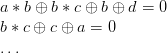
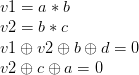
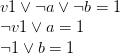
      Basically, you have to create a new variable for each new monomial, and then you have to encode your XORs each with 2^(n-1) clauses, where “n” is the size of the XOR. That’s it :)

  2. i want a program that converts from anf to cnf..
    i tried to install grain of salt. It is showing some installation error. Is there any specific version for boost c++ library to install?

    • Here is one, written in C: http://gitorious.org/anf2cnf/anf2cnf The input format to the “anf2cnf”binary is not trivial, though. An example input is this:

      2065,2073,||
      2307,2315,2744,|2061,|2069,2711,|2069,2719,|2076,|2295,2711,|2295,2719,|2317,2711,|2317,2719,|2711,|14580,||
      251,||

      Monomials are separated with a “|”, and variables inside them are separated with a “,”. The empty monomial is the TRUE constant. So var 251 is set to TRUE here, for example.

      Grain-of-Salt needs some ancient boost library, but I thought it should compile with the newer ones, too. BTW, Grain-of-Salt is not a proper ANF-to-CNF converter. It does that, too, but that particular part is not accessible from the outside, sorry :(

      • I tried the converter said by you in the above link… again it is showing some errors..
        the error was like “MTRand/MersenneTwister.h : No such file or directory” and many errors. I got this particular error when the system was compiling “bestbits.cpp”. I searched for the file in the net and created a directory MTRand and put the file MersenneTwister.h and i tried again and ended up unsuccessful. Will you please guide me for installing the same.

      • Sir,
        I have installed anf2cnf – highdegree…
        after installing, there are four object files. they are “anf2cnf,SATsolve, parseanf,chronoanftocnf” .
        i executed by issuing the command ./anf2cnf
        In the file i gave the input which was given by as an example in the above reply. But it showed me an error as “bad format”.

        • (First of all, forget the “sir” — I am probably younger than you are). Sorry about the missing “MTRand” — I have added it now. It should now compile out of the box if you have a C compiler installed. As for the error with “anf2cnf”, I think your problem may be that you are using Windows, and the end-of-line character is not only a “n” but also a carry-return. You must have only a “n” at the end of each line. Also, don’t leave empty lines, and don’t leave spaces at the end of the lines. For me, the output of that example 3 lines with “anf2cnf” is:


          $ ./anf2cnf myfile
          x1 0
          x4 8 9 12 14 15 17 18 20 11 21 0
          x22 0
          1 -2 -3 0
          -1 2 0
          -1 3 0
          4 -5 -6 -7 0
          -4 5 0
          -4 6 0
          -4 7 0
          9 -10 -11 0
          -9 10 0
          -9 11 0
          12 -10 -13 0
          -12 10 0
          -12 13 0
          15 -16 -11 0
          -15 16 0
          -15 11 0
          17 -16 -13 0
          -17 16 0
          -17 13 0
          18 -19 -11 0
          -18 19 0
          -18 11 0
          20 -19 -13 0
          -20 19 0
          -20 13 0
          c
          c Mapping literals < -> monomials:
          c 1 := x[2065]*x[2073]
          c 2 := x[2065]
          c 3 := x[2073]
          c 4 := x[2307]*x[2315]*x[2744]
          c 5 := x[2307]
          c 6 := x[2315]
          c 7 := x[2744]
          c 8 := x[2061]
          c 9 := x[2069]*x[2711]
          c 10 := x[2069]
          c 11 := x[2711]
          c 12 := x[2069]*x[2719]
          c 13 := x[2719]
          c 14 := x[2076]
          c 15 := x[2295]*x[2711]
          c 16 := x[2295]
          c 17 := x[2295]*x[2719]
          c 18 := x[2317]*x[2711]
          c 19 := x[2317]
          c 20 := x[2317]*x[2719]
          c 21 := x[14580]
          c 22 := x[251]

          If you install “CryptoMiniSat” to the path ($PATH in linux) you can also use “SATSolve” to solve “myfile”, like this:


          ./SATsolve myfile
          propagate: 0.000000
          anf2cnf: 0.000000
          c Outputting solution to file: /tmp/sol.rcQAtO
          c This is CryptoMiniSat 2.9.0
          c WARNING: for repeatability, setting FPU to use double precision
          c Reading file '/tmp/cnf.dWSZzx'
          c -- clauses added: 0 learnts, 25 normals, 2 xors
          c -- vars added 21
          c Parsing time: 0.00 s
          c N st 0 0 21 7 15 0 63 0 no data no data --
          c asymm cl-useful: 0/7/7 lits-rem:0 time: 0.00
          c Flit: 0 Blit: 0 bXBeca: 0 bXProp: 0 Bins: 0 BRemL: 0 BRemN: 0 P: 0.0M T: 0.00
          c bin-w-bin subsume rem 0 bins time: 0.00 s
          c subs with bin: 0 lits-rem: 0 v-fix: 0 time: 0.00 s
          c Subs w/ non-existent bins: 0 l-rem: 0 v-fix: 0 done: 18 time: 0.00 s
          c Removed useless bin: 0 fixed: 0 props: 0.00M time: 0.00 s
          c lits-rem: 0 cl-subs: 0 v-elim: 6 v-fix: 0 time: 0.00 s
          c Finding binary XORs T: 0.00 s found: 0
          c Finding non-binary XORs: 0.00 s (found: 0, avg size: -nan)
          c calculated reachability. Time: 0.00
          c Calc default polars - time: 0.00 s pos: 2 undec: 9 neg: 10
          c =========================================================================================
          c types(t): F = full restart, N = normal restart
          c types(t): S = simplification begin/end, E = solution found
          c restart types(rt): st = static, dy = dynamic
          c t rt Rest Confl Vars NormCls BinCls Learnts ClLits LtLits
          c B st 0 0 12 6 6 0 41 0 no data no data --
          c E st 1 0 0 6 6 0 41 0 no data no data --
          c Verified 7 clauses.
          c Solution needs extension. Extending.
          c Verified 7 clauses.
          c num threads : 1
          c restarts : 1
          c dynamic restarts : 0
          c static restarts : 1
          c full restarts : 0
          c total simplify time : 0.00
          c learnts DL2 : 0
          c learnts size 2 : 15
          c learnts size 1 : 3 (14.29 % of vars)
          c filedLit time : 0.00 (-nan % time)
          c v-elim SatELite : 6 (28.57 % vars)
          c SatELite time : 0.00 (-nan % time)
          c v-elim xor : 0 (0.00 % vars)
          c xor elim time : 0.00 (-nan % time)
          c num binary xor trees : 0
          c binxor trees' crown : 0 (-nan leafs/tree)
          c bin xor find time : 0.00
          c OTF clause improved : 0 (-nan clauses/conflict)
          c OTF impr. size diff : 0 (-nan lits/clause)
          c OTF cl watch-shrink : 0 (-nan clauses/conflict)
          c OTF cl watch-sh-lit : 0 (-nan lits/clause)
          c tried to recurMin cls : 0 (-nan % of conflicts)
          c updated cache : 0 (-nan lits/tried recurMin)
          c clauses over max glue : 0 (-nan % of all clauses)
          c conflicts : 0 (-nan / sec)
          c decisions : 6 (0.00 % random)
          c bogo-props : 440 (inf / sec)
          c conflict literals : 0 (-nan % deleted)
          c Memory used : 11.04 MB
          c CPU time : 0.00 s
          c SAT
          [
          [ #, #, #, #, #, #, #, #, #, #, #, #, #, #, #, #, #, #, #, #, #, #, #, #, #, #, #, #, #, #,
          ...
          #, #, #, #, #, #, #, #, #, #, #, #, #, #, #, #, #, #, #, #, #, 0 ]
          ]

  3. Sir,

    I would like a ANF-to-CNF converter. Where can I download it? And what language is used? (I need to compile with Windows). Thank you for your help.
    Can I speak French with you ?

    Regards,

    Cécilia

  4. Dear msoos,

    I’ve installed anf2cnf – highdegree and i took the same example 3 lines above but I have the error :
    “assertion “false” failed: file “libanf2cnf.cpp”, line 84, function: int hash_monomial
    Aborted “. What did you think about it?

    • Thank you for telling me about this! Sorry, the branch “highdegree” was wrong. It has now been deleted, so it will not confuse others :) The branch to use is “master”. I hope you will find it useful!

      Mate

  5. With reference to your paper titled “Extending SAT Solvers to Cryptographic problems”, I tried for Trivium cipher, and i got the following results
    guess bits time in sec
    10 0.03
    20 0.04
    30 0.043
    40 0.028
    50 0.028
    60 0.02
    I used grain of salt for converting from ANF to CNF. and the command i used was “./grainofsalt –num 100 –outputs 90 –crypto trivium –probBits 20″, For guess bits 20.
    Then i used cryptominisat for calculating the time required for solving the CNF files.
    As far as i understood, if the guess bits decreases then the time required should increase. But in my case the time increases and decreasing again.(The result is shown above). Will you please help me where I have gone wrong?
    Is the time for executing the SAT solver the “CPU time” displayed as the result of executing the SAT solver?

    • Hi,

      90 bits of output is very low for Trivium because if you look at the trivium configuration file, it says:

      init_clock = 0

      which means that initialisation is not part of the configuration — you have to add that yourself. It would mean that you add the correct number in the config file, and you generate the correct

      feedback_init.txt

      files in each of the sr0, sr1, sr2 subdirectories. Otherwise, the program will be generating problems without initialisation — and for that, you need to have as many output bits as the size of the cipher state, which is much more than 90.

      I hope I have helped,

      Mate

  6. Sir

    Can you give example to convert a cubic polynomial as you did with a quadratic equation in this paper

    Thank You

    • Hi,

      For example, the representative ‘int_var1′ of the monomial

      a*b*c

      i.e. the equation

      int_var1 = a*b*c

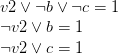
      can be described in CNF like this:

      int_var1 V -a V -b V -c
      -int_var1 V a
      -int_var1 V b
      -int_var1 V c

      All the rest is the same as per the original blog post. I have simply replaced

      int_var1 = a*b

      with

      int_var1 = a*b*c

      changing the equation

      0 = a*b + b*c + b + d

      to

      0 = a*b*c + b*c + b + d

  7. Sir,

    I am trying to implement an anf-cnf converter based on your conversion algorithm, can you tell me the standard format for input file, for anf equations.
    Thank You

  8. Sir,

    I have few doubts regarding your algorithm for conversion:

    1) To convert XOR’s in the given equation:
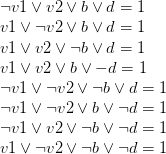
    false = int_var1 + int_var2 + b + d

    You used:
    -int_var1 V int_var2 V b V d = true
    int_var1 V -int_var2 V b V d = true
    int_var1 V int_var2 V -b V d = true
    int_var1 V int_var2 V b V -d = true
    -int_var1 V -int_var2 V -b V d = true
    -int_var1 V -int_var2 V b V -d = true
    -int_var1 V int_var2 V -b V -d = true
    int_var1 V -int_var2 V -b V -d = true

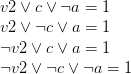
    But For: false = int_var2 + c + a

    You used:
    int_var2 V c V -a = true
    int_var2 V -c V a = true
    -int_var2 V c V a = true
    -int_var2 V -c V -a = true

    According to the first equation clauses, shouldn’t the second equation clauses be these:

    int_var2 V c V -a = true
    int_var2 V -c V a = true
    -int_var2 V c V a = true
    -int_var2 V -c V a = true
    int_var2 V -c V -a = true
    -int_var2 V c V -a = true

    2) The algo you have given is for:
    0 = a*b + b*c + b + d

    What if instead of 0 there was a 1 i.e:
    1 = a*b + b*c + b + d

    Thank you

    • Hi,

      0) (*please* don’t call me sir)

      1) The equations are correct. Think of the clauses as banning solutions. These are not trivial, you have to think through them again and again to understand them. Observe, for instance, that in my solution, the same XOR is only described with the same even/odd number of inversions in the clauses. You have both odd and even number of inversions describing the same XOR — that is impossible.

      2) If there is a constant as well, then the number of inversions goes from odd to even and vice-versa.

      I hope I have helped!

  9. what value should be set to init_clock in case of trivium? do you i have to change sr0,sr1,sr2, feedback_init.txt manually after setting init_clock?

  10. Hi,

    I implemented a anf-cnf converter using C based on the algorithm in this page, however i am now trying to develop a cnf-anf converter and combine them, can you also give the algorithm for cnf-anf conversion.

    Thanks

    • Hi,

      Well, if you have implemented it, why don’t you share it with us? I think it’s only fair that I will give a description of how to do CNF->ANF only if you share your code with us :) It’s a give&take game, not a take&take one ;)

      Mate

  11. Hi,

    Can you please now share the cnf-anf algorithm so that I can make a cnf-anf converter

    Thank You

    • Hi Akshay Gupta,

      I will write a blog post soon about CNF->ANF. In your program, I think you forgot to check the input, and it seems to lack documentation :( It’s best to open an account at gitorious.org, upload your source there, and add a README with input requirements, output format, and some usage info :)

      Mate

  12. Hi Mate,

    Thnks for the feedback :) I am out of town right now. but i will soon post the full anf-cnf convertor with documentation asap.

    Akshay

Leave a Reply

Your email address will not be published. Required fields are marked *

*


*

You may use these HTML tags and attributes: <a href="" title=""> <abbr title=""> <acronym title=""> <b> <blockquote cite=""> <cite> <code> <del datetime=""> <em> <i> <q cite=""> <strike> <strong>