Category Archives: Personal

My Dell Vostro 3560 review

In this post I would like to share with you a personal review of my new business line laptop from Dell, the Vostro 3560. It’s a 15.6″ laptop that has Full HD screen using TN display technology, a 750GB HDD spinning at 7500rpm, 6GB of DDR3 RAM clocked at 1600MHz, with the highest possible Core i7 processor available for this machine, the i7-3612QM, that goes to 3.1GHz with all cores still active.
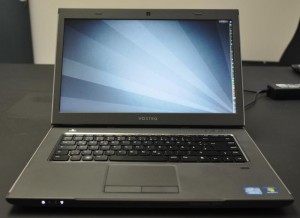
Overview of the laptop

The good

First, let me talk about what I found to be great about this laptop. The display is great: it’s sharp, the colors are good and it’s bright enough even in strong sunlight — though admittedly here in Berlin there is not much of that.

The keyboard is also magnificent. It’s one of the best keyboards I have ever used, even though I am very particular about my peripherals, especially keyboards and mice. I used to own business Thinkpads and this is the first keyboard that I have found to be as good as or maybe even better than a Thinkpad keyboard.

The system is built sturdily, and the materials used don’t feel cheap in your hands. Though the system isn’t light, it feels easy to hold due to its rigidity and smooth (but not slippery) surfaces.

Finally, the system contains extras that are only mentioned in the service manual. For example, there is an mSATA socket inside the laptop, meaning you can plug a 256GB mSATA SSD into the system in a couple of minutes for a reasonable price (around 200EUR), significantly speeding things up.

The mediocre

The CPU is a trade-off. It’s not the i7-3610QM which would go up to 3.3GHz with all cores still active. The reason for this is interestingly not price: the two CPUs cost the same from intel — the reason is heat removal. The CPU installed only generates 35W of heat while the other generates 45W. Essentially, Dell didn’t work hard enough on the cooling system and the result is that a better CPU cannot be installed. Unfortunately, Dell is not the only one that couldn’t install the 3610QM, other manufacturers such as Sony with the Vaio S series had the same issue. Naturally, Apple with the new MacBook Pro lineup didn’t mess this up.

The included charger is rather bulky. Interestingly, there is a slimmer charger available, for a mere 114 EUR — the one included costs 50EUR on the same Dell webpage. I find this to be rather disappointing.
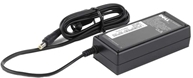
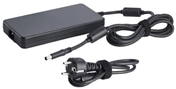
Bulky charger included
Slim charger, available at 114EUR


The wireless card inside the system doesn’t support 5GHz WiFi. This sounds minor, until you go to a conference or a public place with a WiFi where everyone seems to be able to connect, except you. 2.4GHz WiFi uses a band that is substantially more noisy and since routers on that band cover more area, if many people are in the same place, connection can be very spotty. In comparison, my IBM X61t, released in 2007 (!) had 5GHz WiFi, so it’s hardly new technology. In fact, for about 30EUR you can change your WiFi card inside the case for one that supports Bluetooth+802.11abgn, i.e. all that is inside plus 5GHz WiFi. I still cannot understand why a computer that costs 900+ EUR would cheap out on such a component — especially since Dell can get bulk discount, so the upgrade for them would be around 10 EUR at most.

The system comes with a DVD writer included, but I don’t have any use for that. Who uses DVDs nowadays? If I want to watch a movie, I use Blu-Ray — after all, the display is Full HD! Having a Blu-Ray option would have been easy for the manufacturer, as the DVD player included is a standard one, so it can be easily swapped to an internal notebook Blu-Ray reader. Such readers cost around 60EUR at any online retailer. In fact, a Blu-Ray internal writer would cost no more than 80EUR. Dell missed out on this completely, for no good reason. Yes, it’s for business, but even business people need to back up their HDD and a DVD writer with a capacity of 4GB won’t be of any help.

The bad

Build quality is terrible. This is very surprising at this price range and in this category (i.e. business). First off, the screen’s backplate fits so badly to the front that there are holes larger than 2mm on the right side, and almost none on the left:
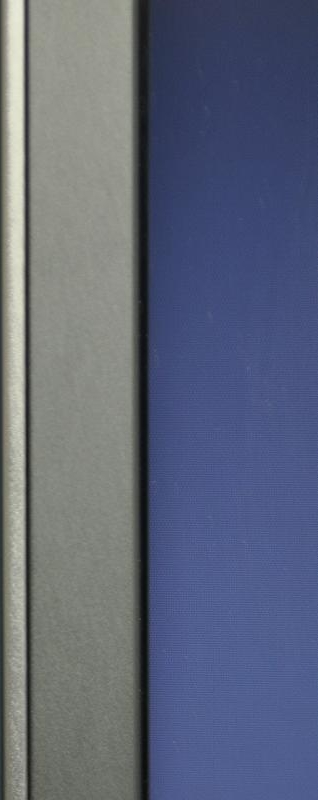
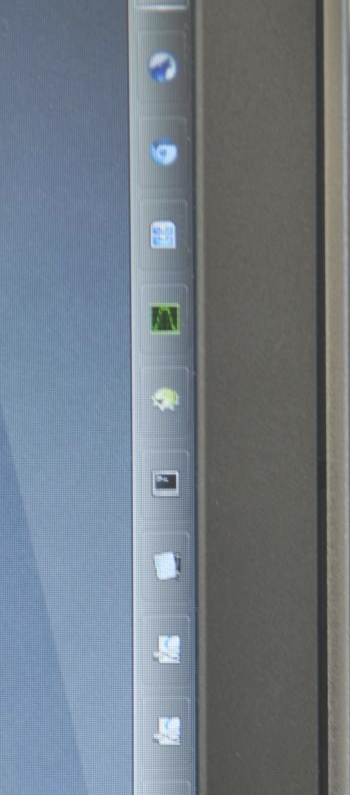
Left side of panel
Right side of panel


The same, though less accentuated, is true for the palmrest. You can clearly see that the plastic fits differently on the two sides, and in fact fits unevenly on both:
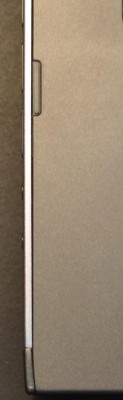
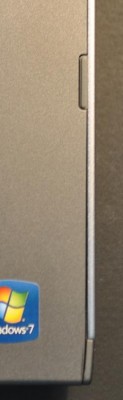
Left side of front
Right side of bottom


Similarly, the bottom sticker of the laptop with the most important piece of information, the Service Tag, is of such a low quality that after only 2 months of use the numbers got completely erased, and only the barcode (blacked out for privacy) remains readable:
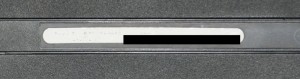
My Service Tag — other than the barcode (blacked out) it’s unreadable


Finally, Linux support is terrible. I wanted to get reimbursed for the Windows 7 licence, but they refused it, which I think is clearly illegal, but of course I don’t have months to waste and money to burn to get some 50-100 EUR back. In the same spirit, there is no proper support for controlling the fan under Linux, as the highest level of the fan cannot be attained with the linux driver, and there is no proper palm detection support for the touchpad. The AMD Linux driver available at the time of purchase crashed X11 at startup, but the new one (fglrx 8.980) is flawless, and I have to commend AMD the on that.

Conclusions

The Vostro 3560 is a nice piece of machine but it’s not quite business quality and its makers prefer not to hear the word Linux uttered. However, if you are ready to shell out some money on a Blu-Ray drive, don’t intend to use Linux and are content with mediocre build quality with holes between elements the size an edge of a penny, the Vostro 3560 is a good choice. Otherwise, maybe hold out for a better offer.

[paypal-donation]
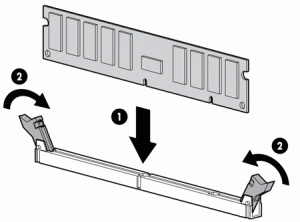
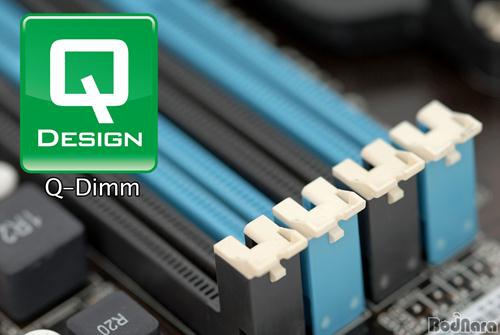
Q-DIMM, an “innovation” by ASUS

Lately, I have been having boot problems with my computer: the system would sometimes fail to boot, and at other times, it displayed the wrong memory readings. I was puzzled, so I took a look. I have six memory DIMMs installed in an ASUS motherboard. Memory modules are usually retained in their slots using two latches:

The point of these latches is to keep the memory modules in place when the computer is moved around. They thus serve the same purpose as the screws for PCIe slots or the mounting holes for the CPU coolers. My motherboard, however, is made by ASUS, and it has a “feature” called Q-DIMM, which is supposed to ease the installation of memory modules when the system has the video card already installed. This “feature” is rather simple: the latch on the right is completely missing:

Unsurprisingly, over time, some of my memory modules simply came out from their slots, making the system completely unstable. And I am far from being the only one who has had this problem.

Most probably the person who came up with this “feature” wasn’t an engineer, but a PR person. It is however rather sad that a technological company such as ASUS should make technical decisions based on PR. By the above logic, I wonder why they didn’t remove both latches. And while they were at it, get rid of all those pesky screw holes for the PCIe slots, and the mounting holes for the CPU cooler, too — things would be much easier to install!

Seriously, though, this is just unbelievable. Fun part is, ASUS sells this “feature” as an innovation that is available only to their high-end (and more expensive) motherboards. I don’t know whether to laugh or cry that you have to spend less to get a more robust, stable system.

CCC Camp’11

In case you’ve missed it, the CCC Camp was a great opportunity to meet people both working in security and otherwise. I have even met a very kind Taiwanese researcher who worked on SAT and Gröbner basis: in fact, if you haven’t had the chance to read this paper, I highly recommend it. A set of kind Taiwanese researchers recommended this paper to me, and I think it’s the most interesting SAT paper I have read in the past year.

We at SRLabs have made two releases during this camp, one that breaks GPRS encryption, and one that breaks smart card ROM encryption. I was involved with the first release, essentially working on the crypto part. In case you are interested in the videos, the one on GPRS is uploaded here, and the one on smart card ROM encryption is here. This reminds me of something: the videos from the MIT SAT/SMT Summer School are missing :( Well, given my fail there, maybe that’s a good thing :)

Winning the SAT Race

The software I developed, CryptoMiniSat 2.5 won the SAT Race of 2010. It is a great honour to win such a difficult race, as there were 19 other solvers submitted from 9 different countries.

Thinking back and trying to answer the question why CryptoMiniSat won, I think there are no clear answers. Naturally, I put immense effort into it, but that is only one part of the picture. Other important factors include those who supported me: my fiancée, the PLANETE project of INRIA, and in particular Claude Castelluccia and my colleagues here in Paris, the LIP6 team and my professor here, Jean-Charles Faugere. As with all randomised algorithms, luck played a good part of winning, too.

In all of this, it is interesting to note that I never had a colleague who worked in or even near the field of SAT: both the PLANETE and the LIP6 team use SAT solvers only as a means to an end, not as an end in itself. In other words, I had to get this far mostly alone. To be honest, I think this is one of the reasons I had won, too: there probably is too much misunderstanding in SAT that everybody takes for granted. Since I never really talked with anyone about their understanding of the subject (I only read papers, which state facts), I had a white paper in front of me, which I could fill with my own intuitions, without being lead by those of others. Naturally, this means that I have probably stepped into a large number things that are widely understood to be wrong, but at the end, it seems that I must have also made some good steps, too.

As for the bad steps I have made (and of which I am aware of), I had copied the subsumption algorithm from SatElite, which the authors of MiniSat told me was a bad move, since its self-subsuming resolution is slow. I had in fact observed this, but I thought it was a fact of life. Alas, it isn’t. Other errors I have made include a non-portable pointer-shortening which shortens pointers to 32 bits when using 64-bit architectures (Armin Biere’s lingeling does this right), and a wrong clause-prefetching code that Norbert Manthey put me right about. I have also conceptually misunderstood the possible impact of variable elimination on the difficulty of resolving an instance, a grave mistake that Niklas Sörensson put me right about.

As for the good steps, I think I have made a couple of them. Firstly, I have put the 2009 SAT paper we wrote with my colleagues to its natural conclusion: including XOR clauses and partial XOR reasoning into the innermost parts of the solver. Secondly, I have used the community to its fullest potential: CryptoMiniSat was used by the constraint solver STP far before the SAT Race began, and it was distributed to a number of highly skilled individuals who made use of it and gave feedback. Sometimes I got very negative feedbacks (these were the most valuable), which highlighted where and why the solver was failing. Thirdly, I have tried to take advantage of the academic environment I work in: I have tried to read the relevant papers, used the clusters provided by the French universities to carry out experiments, and generally took my time (rarely an option in industry) to get things right instead of rushing out a solver.

The 2010 SAT Conference

I am currently at the SAT 2010 conference, in Edinburgh. It is my second SAT conference, but the first one where I finally have a chance to know who is who. I had a chance to talk to some great researchers. For instance, I talked to (in no particular order) Armin Biere (author of PrecoSat and Lingeling), Niklas Een, Niklas Sörensson (authors of MiniSat — new version is out, btw), Marijn Heule (author of the march_* set of solvers), Matti Järvisalo (one of the authors of Blocked Clause Elimination), the author of MiraXT, and many others. It’s really a great place to meet up people and get a grasp on what SAT is really about. It’s also a great way to understand the motivation behind certain ideas, and to hear the problems encountered by others.

For instance, I now know that bugs, about which I have already written a blog post about is a problem that comes up for nearly everyone, and tackling them is one of the most difficult things for the developers. I have also finally understood the reason behind the MiniSat Template Library (MTL), which I’ve always found odd: it re-implements many things in the STL (the Standard Template Library), which I have always found unnecessary. Although the reasons are now clear (better control, easier debugging, less memory overhead), I think I will still replace it with STL. I have also had a chance to talk to the kind reviewer who did such an extensive review of my paper, which was quite an enlightening discussion. If you are interested in SAT, I encourage you to attend next year: there are usually some workshops associated with the conference, where it is easier to have a paper accepted: e.g. this year, a Masters student got his quite interesting paper (long version) accepted, and I am sure he has benefited a lot from it.