Category Archives: SAT

CryptoMiniSat on XNF Benchmarks, Revisited

I was quite hopeful when I first saw the XNF solver 2-Xornado, and then Xorricane, which solve so-called XOR-OR-AND (XNF) problems, i.e. problems written in the format “(a XOR b XOR c) or (f XOR NOT g)”. The two papers about this family of solvers were [PDF1][PDF2], and the results looked impressive. They could outdo CryptoMiniSat, my CNF-XOR solver, on a bunch of instance families. To be honest, I suspected a cutoff being fired, but I was also hopeful and didn’t want to be the annoying person in the way of new research. Then the Xorcle paper dropped [PDF] and my collaborator asked me to take a look. This led me down a rabbit hole of figuring out that in fact, all these years, XNF solvers have been comparing against CryptoMiniSat in a somewhat unflattering way.

CryptoMiniSat has to function as a regular SAT solver as well as perform XOR reasoning, while the XNF solvers only really work well for XNF inputs, and are not so competitive on CNF inputs. In order to balance the requirement of needing to also work on plain CNF input, CryptoMiniSat has a number of cutoffs. For example, it didn’t use more than 3-5 matrices at most by default, and the number of rows and columns in matrices was also limited. However, the instances that the XNF authors were using sometimes had extremely large matrices, and/or very many of them (e.g. over 1000 matrices). Furthermore, some of them contained blasted XOR constraints that are quite long, and would normally be cut up — so CryptoMiniSat’s default recovery limit didn’t check for them. This meant that CryptoMiniSat was often not running XOR reasoning (Gauss-Jordan Elimination, GJE) on many of these instances. Essentially, the defaults made it easy to run benchmarks incorrectly with CryptoMiniSat.

Performance of CryptoMiniSat vs XNF Solvers

I had a go at checking the performance of CryptoMiniSat once these limits were lifted. Unfortunately, it turns out that CryptoMiniSat had a few annoying performance bugs. Firstly, each propagation of GJE ran an algorithm linear in the number of matrices, which didn’t quite work with over 500 matrices. Oops. Secondly, there was a silly limit in the maximum discoverable XOR size, which had to be lifted. Finally, I never thought there’d be more than 1000 matrices, so 1000 was a reserved number, and caused an assertion failure. These had to be fixed.

Once fixed, running CryptoMiniSat with “--autodisablegauss 0 --presimp 1 --maxmatrixrows 100000 --maxmatrixcols 100000 --maxnummatrices 1000000 --minmatrixrows 1 --maxxorsize 12” to lift all the minimum/maximum limits, led to it outperforming all the XNF solvers by a healthy margin. The results are available here. Main graph:
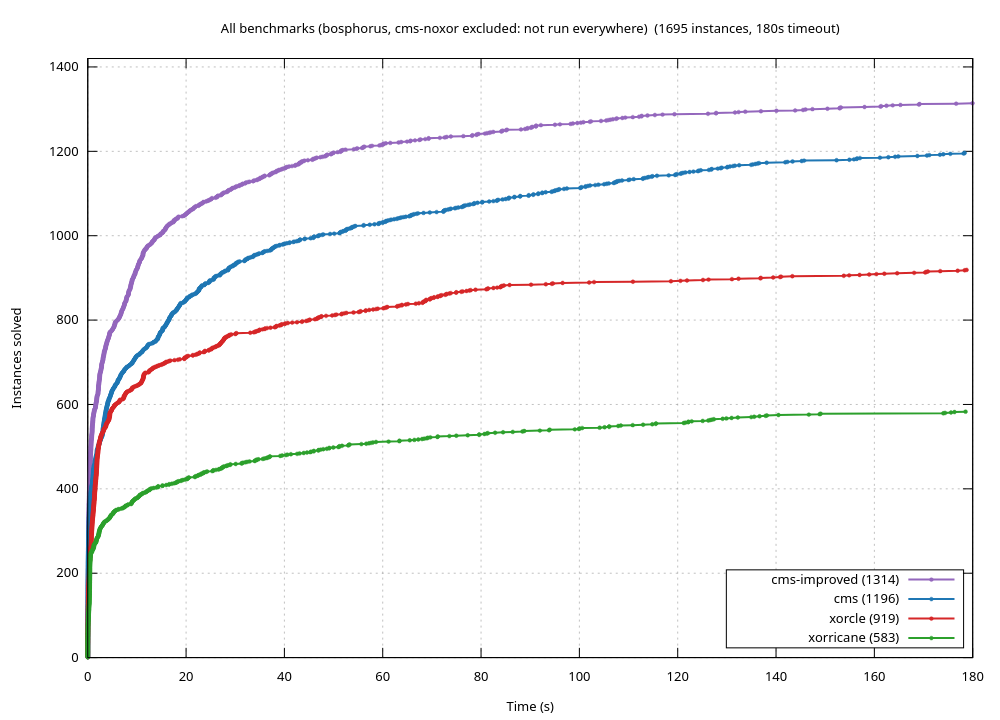
As you can see, CryptoMiniSat (“cms”) with those minor performance changes (changes only needed for “lifted pebbling” and “tseitin” families) and the correct options solves many more instances than the XNF solvers. Moreover, as per the report, it solves almost every family as fast or faster than these solvers, individually, as well.

Then I thought maybe I should spend some time with an AI to fix up CryptoMiniSat, and take ideas from CaDiCaL in the process. So I pointed the AI to CaDiCaL by Armin Biere et al. (a paper on one of its best techniques is here) and let it find all the things that I missed over the past 5-6 years. The result is the “cms-improved” line in the graph above. It took two evenings with AI, and now it’s quite performant, outperforming both Xorcle and Xorricane on every benchmark family except “lifted pebbling” where both Xorcle and CMS finish all benchmarks under 4 seconds or less. The new version of CryptoMiniSat has a better “too slow GJE” detection, so all limits have been lifted by default. So in the future, it should be easier to correctly run such benchmarks with CryptoMiniSat. While this version of CMS is of course better than the old version, it was not really tuned for these benchmarks. I need CMS to perform relatively well on all the things I use it for, and that’s mostly ApproxMC solving and Ganak preprocessing.

Bugs and Fuzzing

I was curious whether these tools were outputting correct solutions. So I took the 20 minutes to ask an AI to write an XNF fuzzer (should be about 2-3h by hand) and test the tools. Unfortunately, the tools seem not to have been tested with a fuzzer. Both had a wrong-answer bug on edge-case inputs, and both had crashes and inconsistencies. Xorricane seems to be faring worse: Xorcle had 4 bugs [here] and Xorricane had 9 [here].

CryptoMiniSat is fuzzed extensively, and has been for a long while. Also it emits a proof for GJE reasoning thanks to the work of Jiong Yang, Yong Kiam Tan et al. [paper]. Actually, I asked an AI to fix up the proof generation, and now it emits a pure XLRUP proof, without needing any refinement via frat-rs (by Mario Carneiro [paper]), which was previously required.

XNF Solving Report

The full XNF solving report is available here, the code, logs, data etc. to generate it are all available here, and the fuzzer is part of that codebase, here. It only took about a weekend to put this together, using AI. I think it’s a rather interesting set of benchmarks, gathered by the authors of Xorcle and Xorricane. All the benchmarks are of course directly sourced via git submodules, so I give credit where credit is due. I also ran Bosphorus [code][paper], our ANF solver, on the relevant problems just for fun. I keep maintaining it as well, and with the new CryptoMiniSat it was performing quite well.

The Future of Research

I have to admit that I feel disappointed by this line of XNF research. I was hoping that something really interesting would come out of it. But seeing that the tools don’t seem to have been fuzz-tested, and overall they are not well-performing on the benchmark sets used by the papers, I am somewhat less optimistic. I still hope that someone will do something really-really cool with CNF-XOR, though. I think it’s more possible than ever before, now that we have AI. In fact, I pointed the AI at the Gauss-Jordan Elimination in CryptoMiniSat, and it found a really cool way of making it several times faster, depending on the matrix size. Thanks to this, ApproxMC, our approximate model counter, is almost twice as fast as before.

However, the question is — what’s the point of research if we can just ask the AI to do a lot of things for us? Tools that are correct? Tools that people want to use and re-use for years, maybe even decades to come? CryptoMiniSat was originally published in 2009, nearly two decades ago. Will today’s CNF-XOR/XNF solvers still be around in 20 years? Would it be rightfully called research or just engineering at that point? Would it be the right use of research time? None of these questions have easy or clear answers. Maybe it’s a waste of time for researchers to write and maintain tools — maybe their job is to come up with cool ideas, and let the industry implement them well/bug-free. Sometimes, it’s best to do fire-and-forget: write the paper, and not deal with it any more, instead let others pick it up and run with it. I personally keep maintaining CryptoMiniSat nearly 2 decades later, along with Arjun, Ganak, Bosphorus, and pepin — but of course, I never really made it in research, either.
Ganakv2 Released

Finally, after many months of waiting for our paper to be accepted (preliminary PDF here), Ganak2 is finally released (GitHub code, released binaries) and easily accessible and modifiable. I wish this release had come earlier, but double-blind requirements didn’t allow us to release the code any sooner.

Basically, Ganakv2 has been re-written in many ways. Some of the original ideas by Thurley for SharpSAT has been kept alive, but many-many things are completely different and completely re-written — well over 10’000 lines of change in total. This set of changes has allowed Ganak2 to win every available track at the Model Counting Competition of 2024. In other words, Ganak2 is incredibly fast, making it a state-of-the-art tool.

Chonological Backtracking, Enhanced SAT solving, S- and D-sets

The new Ganak has a pretty powerful SAT solver engine with its own restart strategy, polarity and variable branching strategy. This SAT solver is tightly integrated into Ganak, and reuses the same datastructures a Ganak, hence the counter/SAT transitions are smooth. This relies on the observation that once every variable in the (minimal) independent set has been assigned, there is at most one solution, so we can just run a SAT solver, there is no need to a full-blown model counter. This idea has existed at least since GPMC, but we improved on it in important ways.

A very complicated but very important aspect of Ganak2 is our integration of Chronological Backtracking which we adopted to the model counting setting. This required a lot of attention to detail, and in order to debug this, we took full advantage of the fuzzer written and maintained by Anna Latour. We further added very serious and thorough checking into Ganak2, with varying levels of internal checking and per-node checking of counts. This allows to perform effective debugging: the first node that the count is incorrect will immediately stop and error-out, along with a full human-readable debug log of what had happened. This was necessary to do, as some of the issues that Chonological Backtracking leads to are highly non-trivial, as mentioned in the paper.

Ganak2 now understands something we call a D-set, which is a set of variables that’s potentially much larger than the projection set but when branched on, the count is the same. This allows Ganak to branch on far more variables than any other current model counter. We run an algorithm that takes advantage of Padoa’s theorem to make this D-set as large as possible. Further, Ganak2 takes advantage of projection set minimization, calling he minimal set an S-set, and running a SAT solver as soon as all variables from the S-set have been decided. This allows us to run a SAT solver much earlier than any other model counter.

Component Discovery, Subsumption and Strengthening, and Counting over any Field

Since the paper, I have also added a number of pretty interesting improvements, especially related to component generation, which is now a highly cache-optimized datastructure, using time stamping, a trick I learned from Heule et al’s brilliant tree-based lookahead paper (worth a read). I also changed the hash function used to chibihash, it’s not only faster (on the small inputs we run it on) but also doesn’t rely on any specific instruction set, so it can be compiled to emscripten, and so Ganak2 can run in your browser.

There is also a pretty experimental on-the-fly subsumption and strengthening that I do. It actually rewrites the whole search tree in order to achieve this, which is a lot harder to do than I imagined. It’s the most trivial subsumption & strengthening code you can imagine, but then the rewriting is hell on earth. However, the rewriting is necessary in case we want to be able to continue counting without restarting the whole counting process.

Ganak, unlike many of its counterparts, also manages memory very tightly and tries not to die due to memory-out. The target memory usage of the cache can be given via –maxcache in MB. A cache size of 2500MB is default, which should cap out at about 4GB total memory usage. More cache should lead to better performance, but we actually won (every available track of) the Model Counting Competition 2024 with rather low memory usage, I think I restricted it to 8-12GB — other competitors ran with ~2x that.

Furthermore, Arjun, our CNF minimizer has also been tuned. While this is not specifically Ganak, it gives a nice improvement, and has some cool ideas that I am pretty happy about. In particular, it runs the whole preprocessing twice, and it incorporates Armin Biere’s CadiBack for backbone detection. I wish I could improve this system a bit, because sometimes CadiBack takes >1000s to run, but without it, it’s even slower to count in most cases. But not always, and sometimes backbone is just a waste of time.

The system also now allows to use any field, all you need to do is implement the +/-/*/div operators and the 0 and 1 constants. I have implemented integers, rationals, modulo prime counting, and counting over a the field of polynomials with rational coefficients. All you need to do is override the Field and FieldGen interfaces. I made it work for modulo prime counting in under 20 minutes, it’s like 30 lines of code.

Floating Point Numbers

Notice that floating point numbers don’t form a field, because 0.3+(0.2+0.1) is not equal to (0.3+0.2)+0.1, i.e. it’s not associative (– thanks to Martin Hořeňovský for this correction, previously I said “commutative”). Actually, Ganak2’s weighted model counting doesn’t currently support floating point numbers, because it doesn’t need to — we won literally every available track with infinite rational numbers: 0.3 is simply interpreted as 3/10. This sounds minor, but it also means that it’s actually trivial to check if Ganak runs correctly — it simply needs to be run with a different configuration and it should produce the same solution. Notice that this is not at all true for any other weighted model counter. Literally all of them, except for Ganak, will give different solutions if ran with different seeds. Which is hilarious, since there is obviously only one correct solution. But since 0.3+(0.2+0.1) is not equal to (0.3+0.2)+0.1 in floating point, they can’t do anything… rational.

This whole floating point saga is actually quite annoying, as it also means we can’t check Ganak against any other counter — at least not easily. All other counters give wrong answers, given that floating point is incorrect, and so we can only compare Ganak2 to other counters if we allow a certain deviation. Which is pretty hilarious, given that counters all claim to use “infinite precision”. In fact, the only thing infinite about their results is likely the error. Since (0.3+(0.2+0.1)) – ((0.3+0.2)+0.1) is not 0, it is actually possible to have theoretically infinite error in case of negative weights.

Approximate Counting and Ganak

Ganak2 incorporates ApproxMC, and can seamlessly transition into counting via approximate model counting methods. To do this, simply pass the “–appmct T” flag, where T is the number of seconds after which Ganak will start counting in approximate mode. This can only be done for unweighted counting, as ApproxMC can only do unweighted counting. However, this seamless transition is very interesting to watch, and demonstrates that using a multi-modal counting framework, i.e. exact+approximate is a very viable strategy.

What happens under the hood is currently unpublished, but basically, we stop the exact counting, check how much we have counted so far, subtract that from the formula, and pass it to ApproxMC. We then get the result from ApproxMC and add the partial count that Ganak counted, and display the result to the user. So the final count is partially approximate, and partially exact, so we actually give better approximation (epsilon and delta) guarantees than what we promise.

Compiling Ganak

The new Ganak incorporates 8 libraries: GNU MP, CryptoMiniSat, Arjun, ApproxMC, SBVA, CadiCal, CadiBack, and BreakID. Furthermore, it and compiles in (optinally) BuDDy, Oracle (from Korhonen and Jarvisalo) and Flowcutter. These are all individually mentioned and printed to the console when running. However, this means that building Ganak is not trivial. Hence, with the very generous help of Noa Aarts, Ganak has a flake nix, so you can simply:

git clone https://github.com/meelgroup/ganak
cd ganak
nix-shell

And it will reproducibly build Ganak and make it available in the path. All this needs is for one to have installed Nix, which is a single-liner and works incredibly reliably. Otherwise, the Ganak repository can be cloned together with its GitHub Actions, and then each push to the repository will build Ganak2 for 4 different architectures: Linux x86&ARM, Mac x86&ARM.

Submit your Version of Ganak to the 2025 Competition

Ganak2 is highly extensible/modifiable. I strongly encourage you to extend/change/improve it and submit your improvement to the Model Counting Competition of 2025. Deadline is in 3 weeks, it’s time to get your idea into Ganak and win. I promise I will have all my changes publicly available until then, and you can literally submit the same thing I will, if you like. I’d prefer if you put in some cool change, though.

On SAT/SMT Model Counting

I have recently had a few discussions with people who wanted to do some form of model counting, and I decided to put my thoughts about this problem into a single blog post, hopefully bringing some light to this area. Firstly, when talking about model counting, it’s very important to think through what one actually needs to achieve. When people talk about a model, they often mean a solution to a problem, described as a set of constraints over either purely boolean variables (so-called propositional model counting) expressed in so-called CNF, or over higher-level constraints, often expressed in SMT-LIB format.

Let’s look at a CNF example:

c this is a comment
c below line means there are 5 boolean variables and 2 constraints
p cnf 5 2
1 -2 0
1 -2 3 0

The above CNF has 5 boolean variables and 2 constraints: “v1 or (not v2) = true”, and “v1 or (not v2) or v3 = true”. In this case, if “v1 or (not v2) = true” is satisfied, the other constraint is also satisfied. So we effectively only have to satisfy the “v1 or -v2” constraint. There are 3 solutions over the variables v1 and v2 to this constraint: (1, 0), (1, 1), and (0,0). For variables v3, v4, and v5 we can choose anything. So there are a total of 3*2^3 = 24 solutions to this CNF.

Let’s look at an SMT problem:

(set-logic QF_BV) ; Set the logic to Quantifier-Free BitVectors
(declare-fun bv () (_ BitVec 8)) ; Declare an 8-bit value
(assert (not (= bv #x00))) ; Assert that 'bv' is not equal to zero

In this SMT-LIB problem, we declared that the logic we will be using is the so-called quantifier-free bitvector logic, which basically gives you access to fixed-width variables such as uint8_t, and of course all the logical and fixed-bit bitwector operators such as modulo addition, division, subtraction, etc. In this particular case, we declared an 8-bit variable and banned it from being 0, so this problem has 2^8-1 solutions, i.e. 255.

Whichever format is being used, “counting” of solutions is something that may sound trivial (it’s just a number!), but once we get a bit more fiddly, it turns out that we can do many things that are actually easier, or even harder, than just counting, even though they sound very close to, or are even synonymous with, counting :

  • Figuring out if there is at least one solution. This is more appropriately called satisfiability checking. This is significantly easier than any notion of counting listed below. However, even this can be challenging. Typically, in the SMT/SAT competition, this is the so-called SMT single query track or the SAT competition Main Track. All SAT and SMT solvers such as kissat or cvc5 can run this kind of task.
  • Next up in complexity is to figure out if there is exactly one solution. This is actually very close to satisfiability checking, and requires only two so-called “incremental calls” to the SMT/SAT solver. I have seen this question pop up a lot in zero-knowledge (ZK) circuit correctness. What is needed is to run the query as per the above, but then add a constraint that bans the solution that is output by the solver, and ask the system to be solved again. If the solver outputs UNSAT, i.e. unsatisfiable, then we know there are no more solutions, and we are happy with the result. If not, it gives us another solution, which is a witness that there are at least two solutions. These queries are answered by so-called incremental SMT solvers (SMT competition track here), or incremental SAT solvers (incremental SAT competition track here). Almost all SAT and SMT solvers can work incrementally, for example cvc5 or z3. Most SAT solvers work incrementally, too, but e.g. kissat does not, and you need to use CaDiCaL instead.
  • Next up in complexity is to approximately count the solutions. Here, we are not interested that there are exactly, say, 87231214 solutions, instead, we are happy to know that there are approx 2^26 solutions. This is often good enough, in case one wants to e.g. figure out probabilities. There are very few such systems available, for SMT there is csb, and for SAT there is ApproxMC. For the special case of approximate DNF counting, I’d recommend pepin.
  • Next up in the complexity is exactly counting the solutions. Here, we want to know how many solutions there are, exactly, and we really-really need the exact number. There are few solutions to doing this over SMT, but doing this over SAT is quite developed. For SMT, I would recommend following the csb approach, and running Ganak on the blasted SAT formula instead of ApproxMC, and for SAT, there is the annual model counting competition, where Ganak won every single category this year, so I’d recommend Ganak.
  • Next up is model enumeration where it’s not enough to count the solutions, but we need a way to compactly represent and store them all. This of course requires quite a bit of disk space, as there could be e.g. 2^100 solutions, and representing them all, even in a very compact format with lots of smart ideas can take a lot of space — but not necessarily exponential amount. Currently, there is no such system for SMT, and my understanding is that only the d4 model counter can do this on SAT/CNF problems, thanks to its proof checking system, in part thanks to Randal Byrant. Once Ganak can output a proof, it will also be able to do this.

All in all, there is a very large gap between “find if there is exactly one solution” and “enumerate all solutions” — even though I have seen these two notions being mixed up a few times. The first might take only a few seconds to solve, while the other might not even be feasible, because compactly representing all solutions may be too expensive in terms of space (and that’s not even discussing time).

One aspect to keep in mind is that often, one does not need all solutions. For example, if one only wants to find a good set of example solutions, then it is possible to use uniform-like samplers, that give a “somewhat uniform” set of example solutions from the solution space (without guarantees of uniformity). A good tool for this is cmsgen for CNF/SAT problems. If one needs a guaranteed uniform set of samples (to be exact, a probabilistically approximately uniform sample), then unigen is the way to go. Obviously, it’s quite easy to find a uniform sample once we have an enumeration of all solutions — simply pick a random one from the whole set — but that’s way more expensive than running unigen.

While all of the above is about counting, it’s often the case that one wants to optimize for something within the solution space. Basically, we have some kind of objective function that we want to optimize for (e.g. maximize profit, minimize loss) , and so we are looking for a solution that maximizes/minimizes some property. Of course, once we have done model enumeration, it’s quite easy to do this — simply run the objective function on all solutions, and pick the best! But that’s really hard. Instead, one can formulate the problem as a so-called MaxSAT or an SMT problem with an objective function. These systems run some really smart algorithms to significantly cut down search time, and even often keep a “best so far” solution around, so we can early-abort them and still get some kind of “best so far” solution.

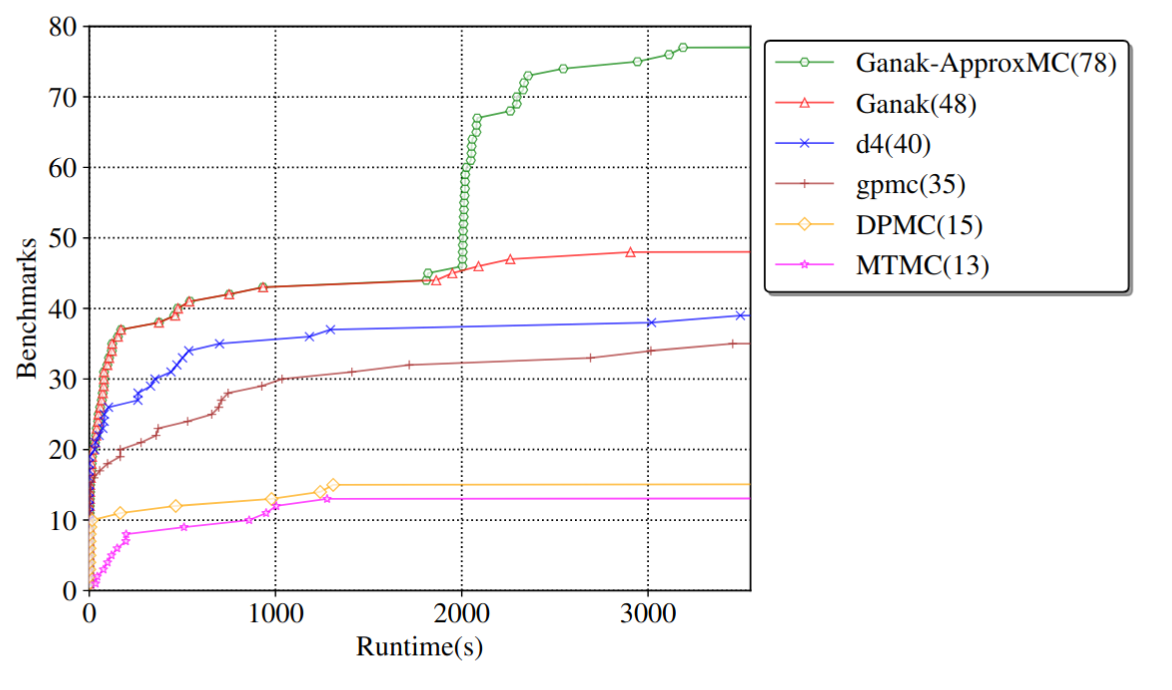
All in all, it’s extremely important to figure out what one actually needs, because there are vast gaps in complexity between the problems (and corresponding algorithms) above. Even between something like approximate and exact counting, the gap is gigantic, as there are huge swaths of problems that are almost trivial to count approximately, but essentially impossible to exactly count with current technology:

Here, the green line is a tool that changes its behaviour from exact to approximate model counting after 1800 seconds of solving, and the number of solved instances jumps significantly. Notice that the red line, the original system it runs for 1800s, is the best in class here, by a wide margin, and still the approximate counting that Ganak+ApprocMC switches into shows a massive difference.

Our tools for solving, counting and sampling

This post is just a bit of a recap of what we have developed over the years as part of our toolset of SAT solvers, counters, and samplers. Many of these tools depend on each other, and have taken greatly from other tools, papers, and ideas. These dependencies are too long to list here, but the list is long, probably starting somewhere around the Greek period, and goes all the way to recent work such as SharpSAT-td or B+E. My personal work stretches back to the beginning of CryptoMiniSat in 2009, and the last addition to our list is Pepin.

Overview

Firstly when I say “we” I loosely refer to the work of my colleagues and myself, often but not always part of the research group lead by Prof Kuldeep Meel. Secondly, almost all these tools depend on CryptoMiniSat, a SAT solver that I have been writing since around 2009. This is because most of these tools use DIMACS CNF as the input format and/or make use of a SAT solver, and CryptoMiniSat is excellent at reading, transforming , and solving CNFs. Thirdly, many of these tools have python interface, some connected to PySAT. Finally, all these tools are maintained by me personally, and all have a static Linux executable as part of their release, but many have a MacOS binary, and some even a Windows binary. All of them build with open source toolchains using open source libraries, and all of them are either MIT licensed or GPL licensed. There are no stale issues in their respective GitHub repositories, and most of them are fuzzed.

CryptoMiniSat

CryptoMiniSat (research paper) our SAT solver that can solve and pre- and inprocess CNFs. It is currently approx 30k+ lines of code, with a large amount of codebase dedicated to CNF transformations, which are also called “inprocessing” steps. These transformations are accessible to the outside via an API that many of the other tools take advantage of. CryptoMiniSat used to be a state-of-the-art SAT solver, and while it’s not too shabby even now, it hasn’t had the chance to shine at a SAT competition since 2020, when it came 3rd place. It’s hard to keep SAT solver competitive, there are many aspects to such an endeavor, but mostly it’s energy and time, some of which I have lately redirected into other projects, see below. Nevertheless, it’s a cornerstone of many of our tools, and e.g. large portions of ApproxMC and Arjun are in fact implemented in CryptoMiniSat, so that improvement in one tool can benefit all other tools.

Arjun

Arjun (research paper) is our tool to make CNFs easier to count with ApproxMC, our approximate counter. Arjun takes a CNF with or without a projection set, and computes a small projection set for it. What this means is that if say the question was: “How many solutions does this CNF has if we only count solutions to be distinct over variables v4, v5, and v6?”, Arjun can compute that in fact it’s sufficient to e.g. compute the solutions over variables v4 and v5, and that will be the same as the solutions over v4, v5, and v6. This can make a huge difference for large CNFs where e.g. the original projection set can be 100k variables, but Arjun can compute a projection set sometimes as small as a few hundred. Hence, Arjun is used as a preprocessor for our model counters ApproxMC and GANAK.

ApproxMC

ApproxMC (research paper) is our probabilistically approximate model counter for CNFs. This means that when e.g. ApproxMC gives a result, it gives it in a form of “The model count is between 0.9*M and 1.1*M, with a probability of 99%, and with a probability of 1%, it can be any value”. Which is very often enough for most cases of counting, and is much easier to compute than an exact count. It counts by basically halfing the solution space K times and then counts the remaining number of solutions. Then, the count is estimated to be 2^(how many times we halved)*(how many solutions remained). This halfing is done using XOR constraints, which CryptoMiniSat is very efficient at. In fact, no other state-of-the-art SAT solver can currently perform XOR reasoning other than CryptoMiniSat.

UniGen

UniGen (research paper) is an approximate probabilistic uniform sample generator for CNFs. Basically, it generates samples that are probabilistically approximately uniform. This can be hepful for example if you want to generate test cases for a problem, and you need the samples to be almost uniform. It uses ApproxMC to first count and then the same idea as ApproxMC to sample: add as many XORs as needed to half the solution space, and then take K random elements from the remaining (small) set of solutions. These will be the samples returned. Notice that UniGen depends on ApproxMC for counting, Arjun for projection minimization, and CryptoMiniSat for the heavy-lifting of solution/UNSAT finding.

GANAK

GANAK (research paper, binary) is our probabilistic exact model counter. In other words, it returns a solution such as “This CNF has 847365 solutions, with a probability of 99.99%, and with 0.01% probability, any other value”. GANAK is based on SharpSAT and some parts of SharpSAT-td and GPMC. In its currently released form, it is in its infancy, and while usable, it needs e.g. Arjun to be ran on the CNF before, and while competitive, its ease-of-use could be improved. Vast improvements are in the works, though, and hopefully things will be better for the next Model Counting Competition.

CMSGen

CMSGen (research paper) is our fast, weighted, uniform-like sampler, which means it tries to give uniform samples the best it can, but it provides no guarantees for its correctness. While it provides no guarantees, it is surprisingly good at generating uniform samples. While these samples cannot be trusted in scenarios where the samples must be uniform, they are very effective in scenarios where a less-than-uniform sample will only degrade the performance of a system. For example, they are great at refining machine learning models, where the samples are taken uniformly at random from the area of input where the ML model performs poorly, to further train (i.e. refine) the model on inputs where it is performing poorly. Here, if the sample is not uniform, it will only slow down the learning, but not make it incorrect. However, generating provably uniform samples in such scenarios may be prohibitively expensive. CMSGen is derived from CryptoMiniSat, but does not import it as a library.

Bosphorus

Bosphorus (research paper) is our ANF solver, where ANF stands for Algebraic Normal Form. It’s a format used widely in cryptography to describe constraints over a finite field via multivariate polynomials over a the field of GF(2). Essentially, it’s equations such as “a XOR b XOR (b AND c) XOR true = false” where a,b,c are booleans. These allow some problems to be expressed in a very compact way and solving them can often be tantamount to breaking a cryptographic primitive such as a symmetric cipher. Bosphorus takes such a set of polynomials as input and either tries to simplify them via a set of inprocessing steps and SAT solving, and/or tries to solve them via translation to a SAT problem. It can output an equivalent CNF, too, that can e.g. be counted via GANAK, which will give the count of solutions to the original ANF. In this sense, Bosphorus is a bridge from ANF into our set of CNF tools above, allowing cryptographers to make use of the wide array of tools we have developed for solving, counting, and sampling CNFs.

Pepin

Pepin (research paper) is our probabilistically approximate DNF counter. DNF is basically the reverse of CNF — it’s trivial to ascertain if there is a solution, but it’s very hard to know if all solutions are present. However, it is actually extremely fast to probabilistically approximate how many solutions a DNF has. Pepin does exactly that. It’s one of the very few tools we have that doesn’t depend on CryptoMiniSat, as it deals with DNFs, and not CNFs. It basically blows all other such approximate counters out of the water, and of course its speed is basically incomparable to that of exact counters. If you need to count a DNF formula, and you don’t need an exact result, Pepin is a great tool of choice.

Conclusions

My personal philosophy has been that if a tool is not easily accessible (e.g. having to email the authors) and has no support, it essentially doesn’t exist. Hence, I try my best to keep the tools I feel responsible for accessible and well-supported. In fact, this runs so deep, that e.g. CryptoMiniSat uses the symmetry breaking tool BreakID, and so I made that tool into a robust library, which is now being packaged by Fedora, because it’s needed by CryptoMiniSat. In other words, I am pulling other people’s tools into the “maintained and supported” list of projects that I work with, because I want to make use of them (e.g. BreakID now builds on Linux, MacOS, and Windows). I did the same with e.g. the Louvain Community library, which had a few oddities/issues I wanted to fix.

Another oddity of mine is that I try my best to make our tools make sense to the user, work as intended, give meaningful (error) messages, and good help pages. For example, none of the tools I develop call subprocesses that make it hard to stop a computation, and none use a random number seed that can lead to reproducibility issues. While I am aware that working tools are sometimes less respected than a highly cited research paper, and so in some sense I am investing my time in a slightly suboptimal way, I still feel obliged to make sure the tax money spent on my academic salary gives something tangible back to the people who pay for it.